TAKAKRYPT Architecture
Overview
This architecture illustrates the communication process between Client Apps, TAKAKRYPT, and the Database within a data security mechanism using a centralized security service. The system is designed so that data protection processes such as encryption, tokenization, and masking are performed through the TAKAKRYPT service using a REST API secured with the HTTPS protocol.
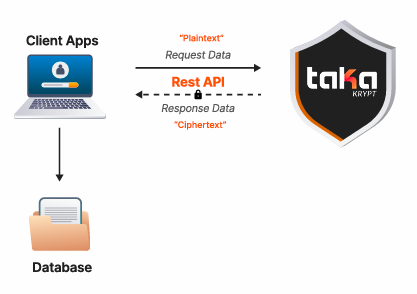
The following is a detailed explanation of the TAKAKRYPT system architecture:
Main Components
This architecture consists of several main components as follows:
Client Apps
Client Apps are applications used by users or systems to access services and data. This component functions as the sender of requests and the receiver of responses from the TAKAKRYPT service.
Main functions:
- Send data requests to TAKAKRYPT through the REST API
- Send data in plaintext form to be processed
- Receive data responses that have been secured
- Interact with the Database for storing or retrieving data
TAKAKRYPT
TAKAKRYPT serves as the center of data security services and data protection management.
Main functions:
- Provide REST API services for data security
- Receive data requests from Client Apps
- Perform the following processes:
- Data encryption
- Data tokenization
- Data masking
- Produce protected data before sending it back to the application
- Maintain communication security using HTTPS
- Serve as the data security control center
Database
The Database is used as the storage medium for application data.
Main functions:
- Store application data
- Store data that has been protected by TAKAKRYPT
- Support the storage of encrypted data or tokenized data to enhance data security
System Communication Flow
1. Sending the Data Request
Client Apps send a data request to TAKAKRYPT through the REST API using an HTTPS connection. The data sent is still in plaintext form.
2. Data Protection Process
TAKAKRYPT receives the request and then processes the data according to security needs, such as:
- Data encryption
- Data tokenization
- Data masking
3. Sending the Response
After the security process is complete, TAKAKRYPT returns the data response to the Client Apps in the form of protected data, such as ciphertext and masked data.
4. Storing Data to the Database
The Client Apps then store the protected data in the Database so that the stored data has a higher level of security.